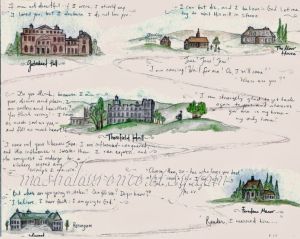
Jane Eyre Ch 18-31
enough to be your father, or as young as children should be “
“We shall get you off cannily Dick: and it will be better, bot for your sake, and for that poor creature in yonder. I have striven long to avoid exposure, and I should not like it to come at last” (295)
“But I had fastened the door — I had the key in my pocket: I should have been a careless shepherd if I had left a lamb — my pet lamb — so near a wolf’s-den, unguarded: you were safe” (298)
“It is a happy thing that time quells the longings of vengeance, and hushes the promptings of rage and aversion. I had left this woman in bitterness and hate, and I came back to see her now with no other emotion that a sort of ruth for her great sufferings, and a strong yearning to forget and forgive all injuries — to be reconciled, and clasp hands in amity” (314)
“In the deep shade, at the further end of the room, a figure ran backwards and forwards. What it was, whether beast or human being, one could not, at first sight, tell: it grovelled, seemingly on all fours; it snatched and growled like some strange wild animal: but it was covered with clothing; and a quantity of dark, grizzled hair, wild as a mane, hid its head and face” (380)
“Jane Eyre, who had been an ardent, expectant woman — almost a bride — was a cold, solitary girl again: her life was pale; her prospects were desolate” (383)
“You may take the maniac with you to England; confine her with due attendance and precautions at Thornfield; then travel yourself to what cline you will, and form what new tie you like. That woman, who has so abused your long-suffering — so sullied your name; so outraged your honour; so blighted your youth –is not your wife; nor are you her husband. See that she is cared for as her condition demands, and you have done all that God and humanity require of you” (399)
“The lunatic is both cunning and malignant; she has never failed to take advantage of her guardian’s temporary lapses” (400)
“No reflection was to be allowed now: not one glance was to be cast back; not even one forward. Not one thought was to be given either to the past, or to the future” (412)